
If you have ever been dismayed trying to pick the perfect area rug, this is everything you need to know to learn how to choose a rug for a room.
We're talking about selecting the right rug size by room, different rug materials based on use, and helpful tips for buying rugs online. At the end, you should feel more confident choosing a rug for your own home, no matter the space.
Read on for the in-depth details to help you select the perfect area rug to bring your space together!
This post may contain affiliate links which we may receive a small commission when some items are purchased at no additional cost to you. As an Amazon Associate we earn from qualifying purchases. Read the full disclosure.
A Brief Rug Story
When we bought our home several years ago, I set about trying to find the perfect area rug for our living room. We have hardwood floors that I wanted to protect under furniture. As a stop-gap until I found a rug that suited our space and my design style, I purchased a fairly inexpensive rug.
Without the ability to see the rug in person, I wanted the rug to be as neutral as possible with a subtle pattern. Mind you, it was 2020 so finding in-stock rugs online, among many other things, was a challenge. However, I managed to find this 9x12 ivory/light grey Safavieh rug with a very subtle pattern.
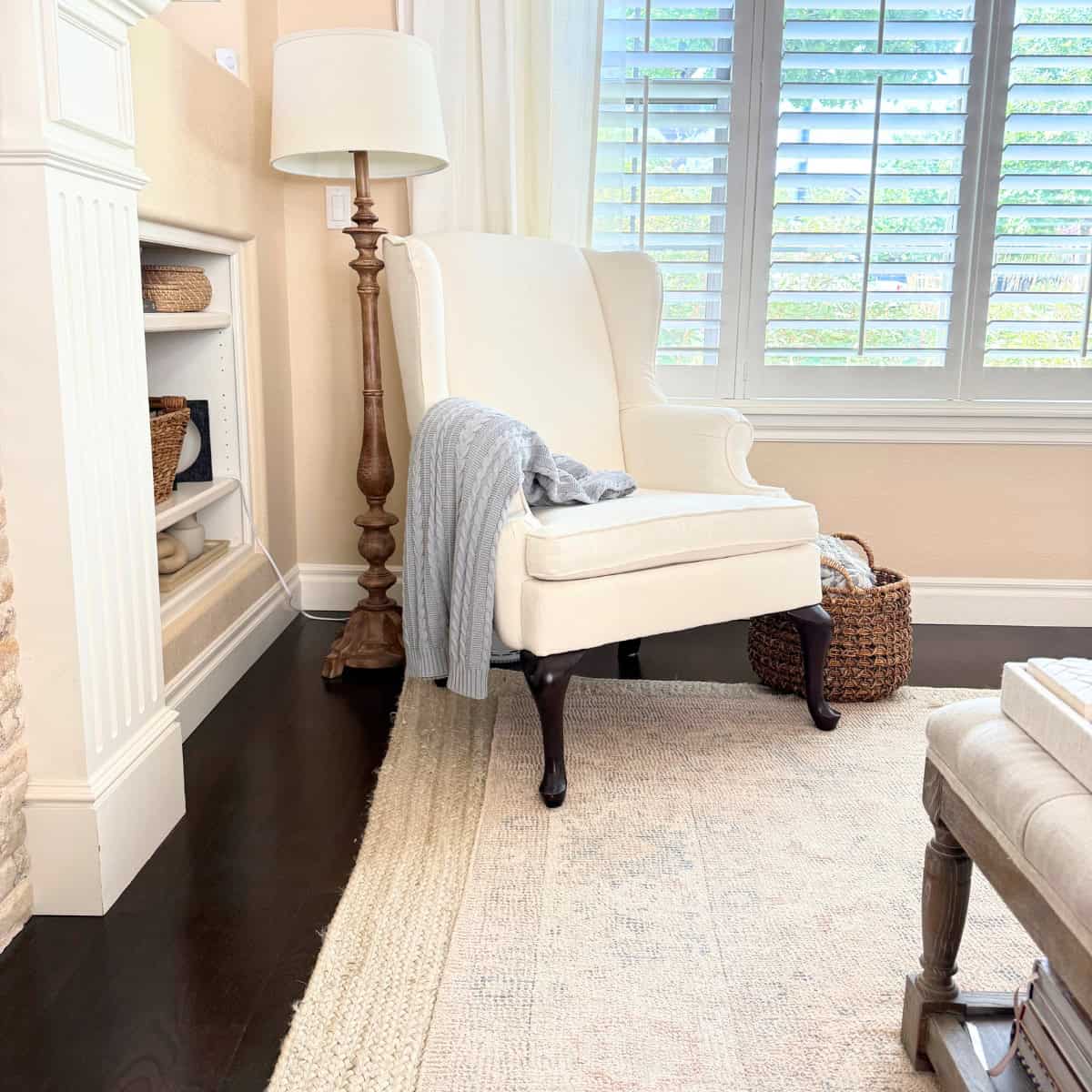
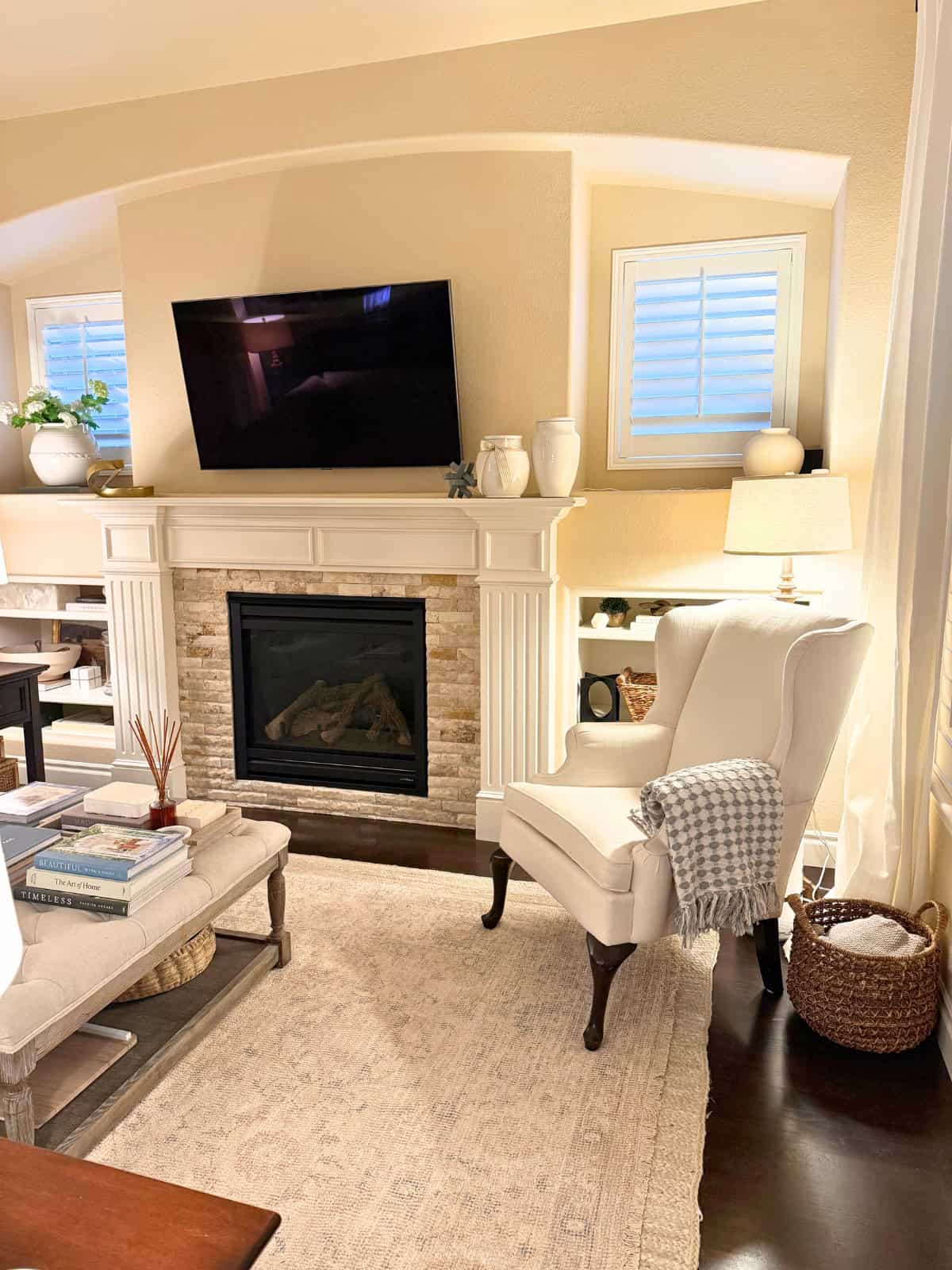
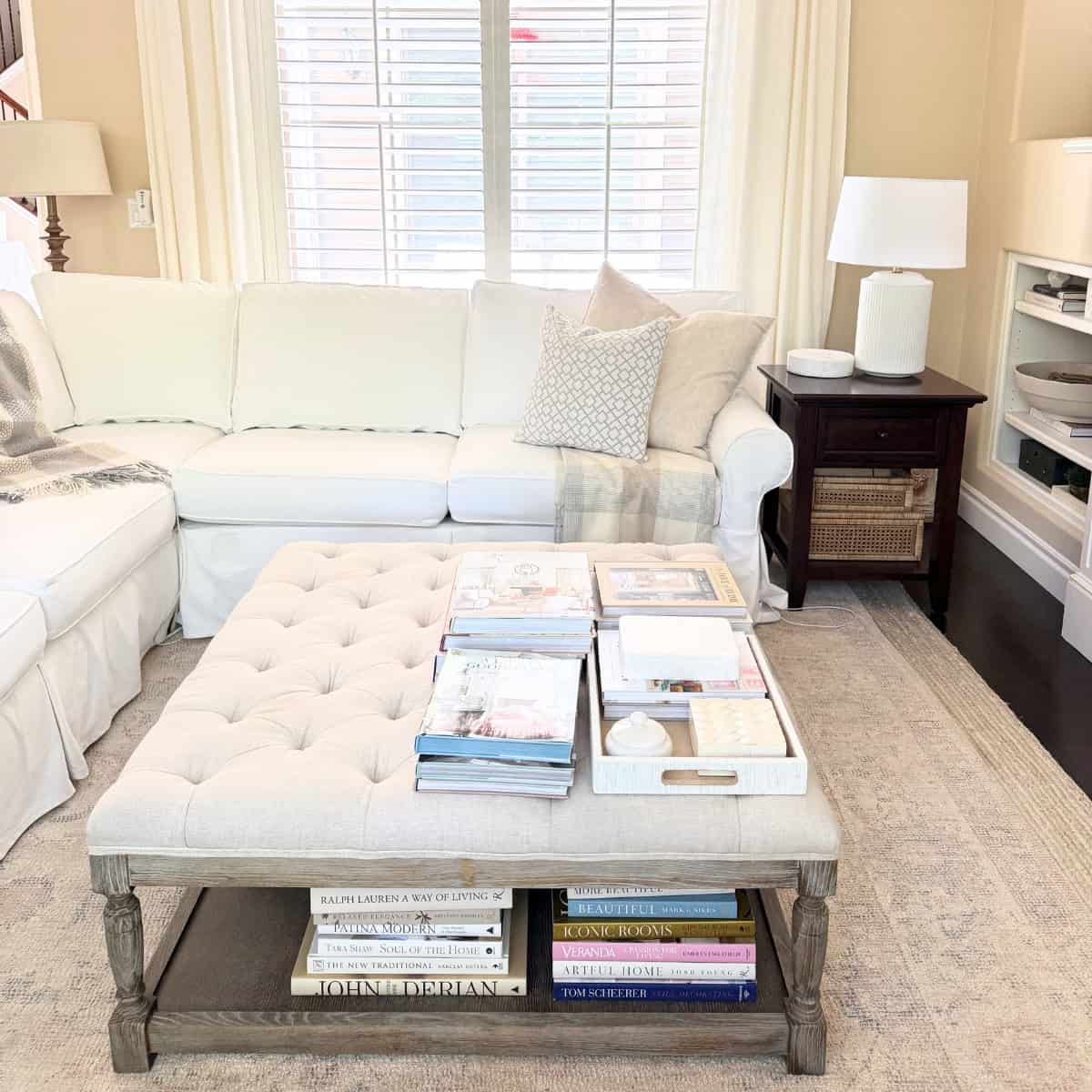
You can see the rug in the photos below from when we had it.

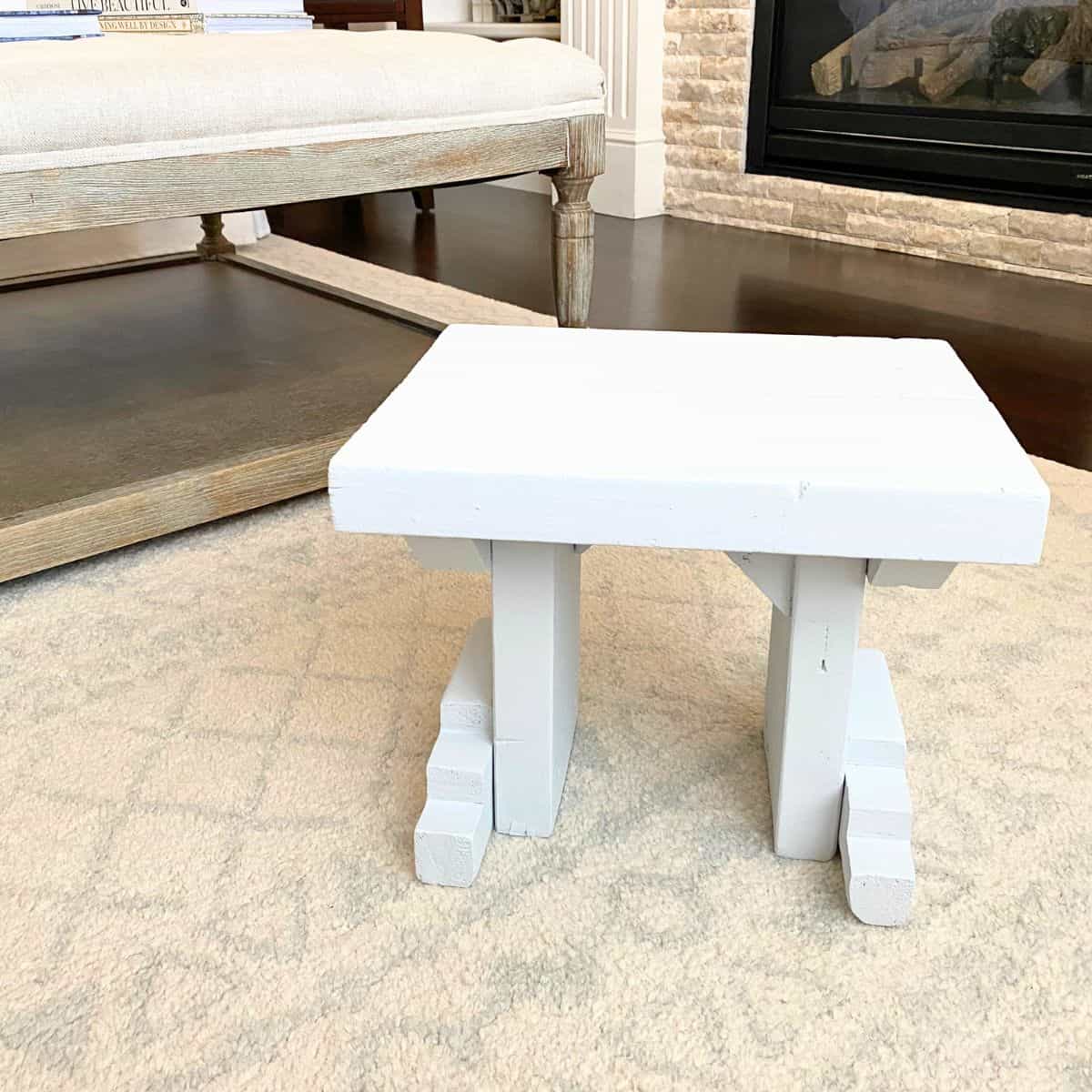
It was a little small for our living room, but it was what I could find at the time and it worked until I could get something better. We had that rug for much longer than anticipated, about four years, when I finally made a deliberate effort to find the perfect area rug.
What I found was that the whole process of choosing an area rug can be challenging. With these tips, and a little effort, I hope you find it easier to choose a rug that works for your home.
In the end, I purchased a gorgeous vintage inspired rug by the well-known rug purveyor, Loloi. With a subtle pattern, and beautiful, but not too faded colors, it is my favorite rug. I layered it on top of a larger braided jute rug to fill the space better, as well as to give our living room texture and interest.
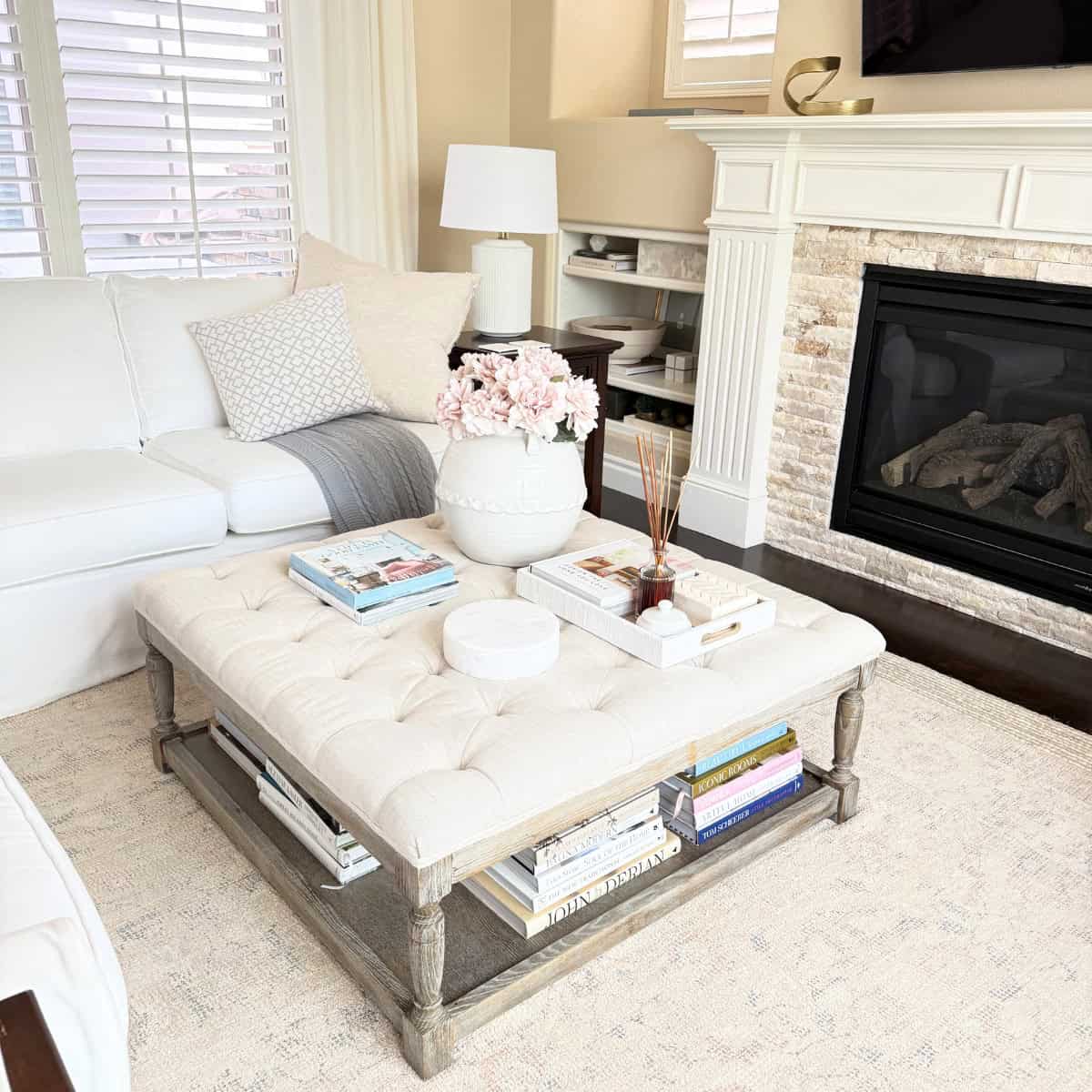
Shop the photo: Large white vase | Beige pink faux peonies | Similar but slightly smaller tufted upholstered ottoman | Coffee table books
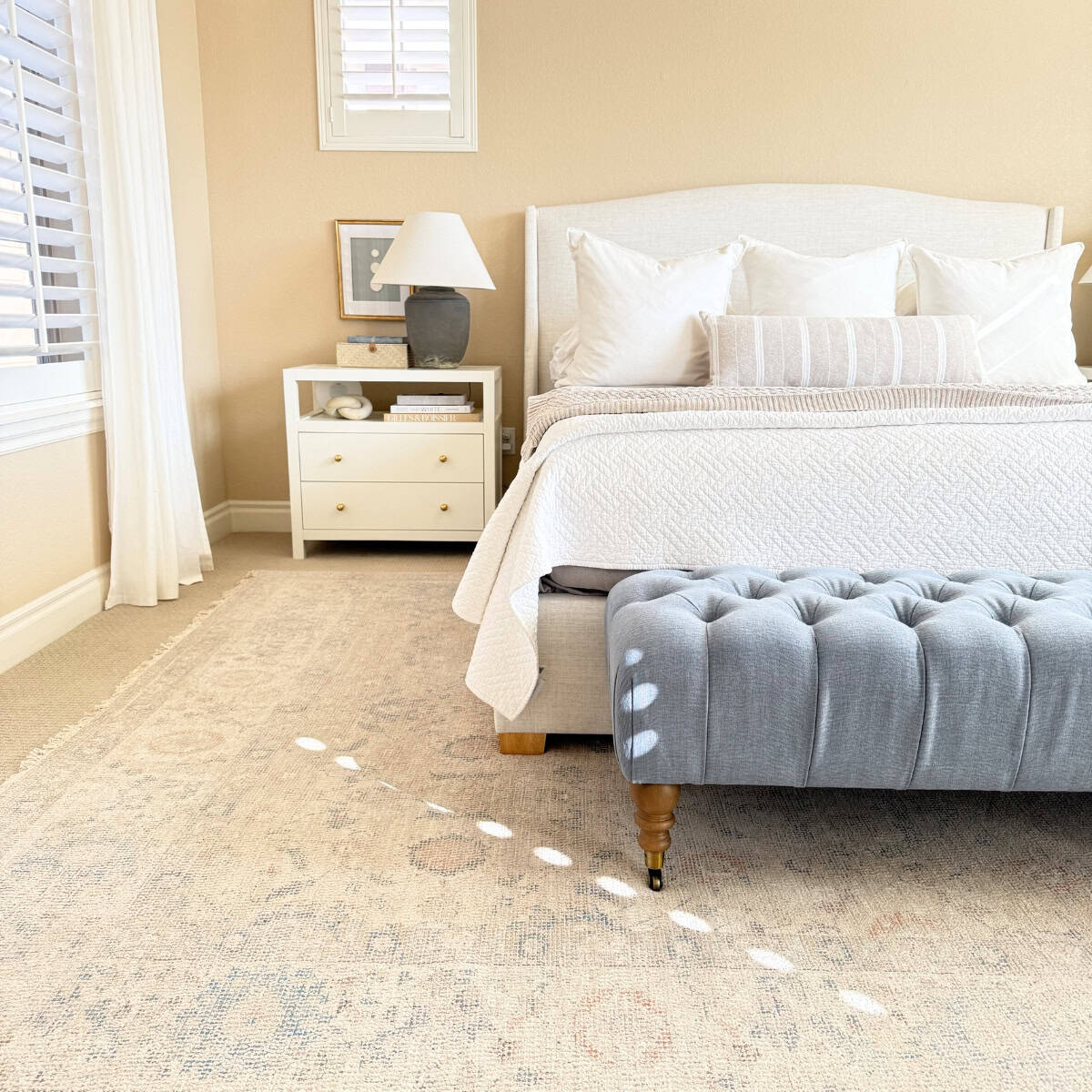
We own two of the same Loloi rug now: one in our living room and a second in our primary bedroom. You can read more details in the Loloi Rug Review - Priya/Amanda Area Rug post. You can see more photos in the Allis Upholstered Bed - Alternative to Tilly or Hanson post.
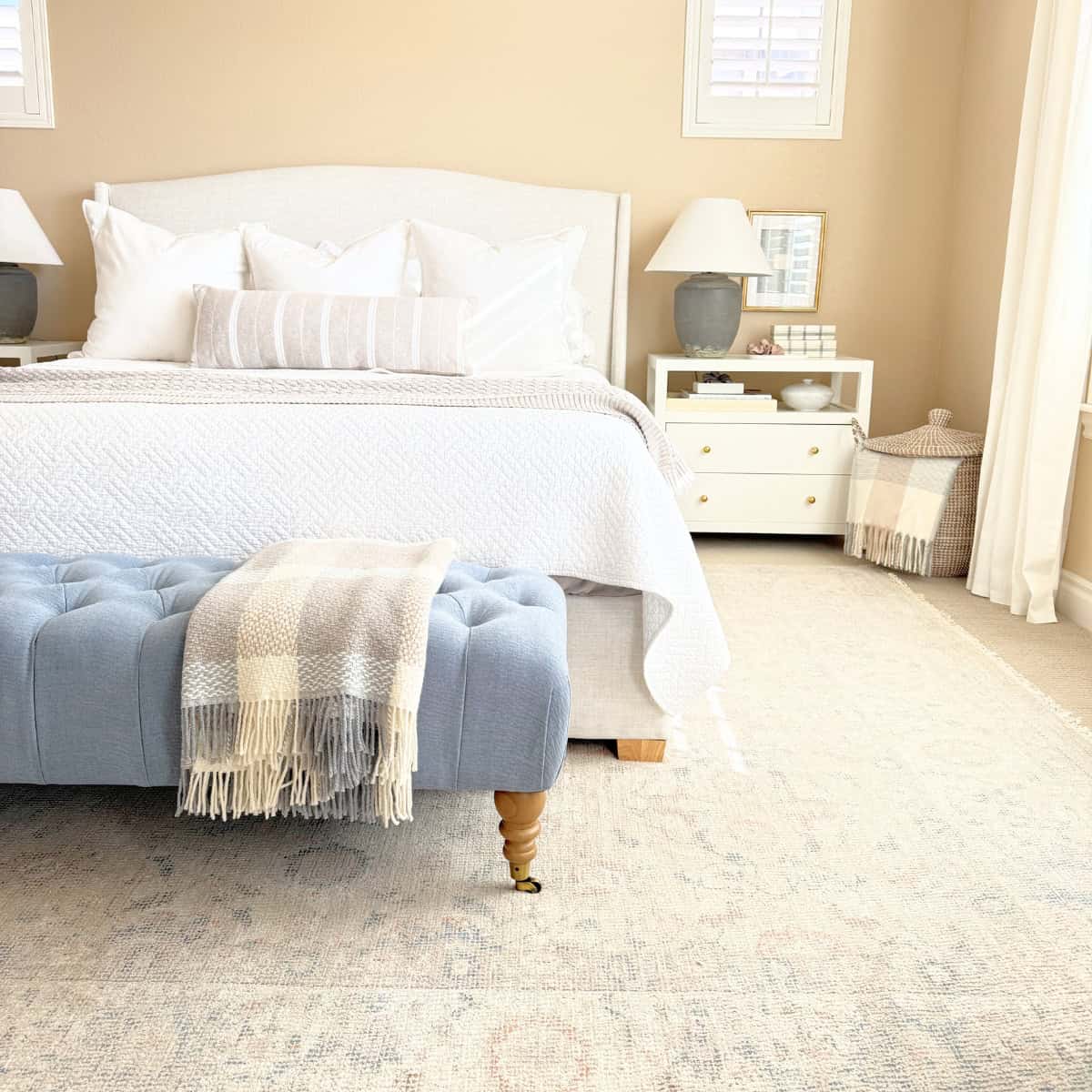
Shop the photo: Alpaca plaid throw blanket (similar) | Plaid grid bone inlay box (small and large) | End of bed bench (similar)
Tips for Buying Rugs
Before anything, you need to know some basics when it comes to buying rugs. What may seem like an easy task reveals itself as more than that once you start looking.
Important: A Word of Caution!
Every screen you view anything on online may be a different color than the real color is in person. All of my photos are filtered and adjusted to fit the Mornington Lane brand identity, including brightening the image. That means the actual rug will look slightly different in person. While the pictures provided will give you a very good idea of what to expect, be aware that variation in color will occur.
In the end, you can buy whatever rug you want. That said, if you want to avoid a potentially costly mistake, here are a few tips for buying rugs that you may find helpful:
- See the rug in person or get a sample - If you can see the rug in person, do so. Bring paint samples and furniture samples with you and hold them up to the rug to see if they complement one another. Otherwise, if you can, buy a sample online so you can gauge how it will look with your furnishings, lighting, and paint.
- Find reviews with pictures - Check reviews online for photos of the rug. Sometimes review lighting isn't great, but it can give you a much better idea of the actual colors in a real photo versus the marketing photos. For rugs on Etsy, ask the seller if they can take pictures of the rug in natural light or even a couple different lighting scenarios.
- Check the return policy - Before you buy any rug, check the retailer's return policy. You never really know what a rug will look like until it is in your home. Be prepared and know what the return policy is.
- Get a rug pad - Not only do rug pads provide cushioning under foot and protect the flooring underneath, rug pads can extend the life of a rug. Even for rugs placed under heavy furniture, get a rug pad. For different rugs in our house, I have this rug pad that comes in many sizes and these rug pad grippers. These may or may not work for you, so check that they can be used on your particular flooring and that they work for your needs before purchasing.
What Rug Material is Right for You
Do you prefer natural materials? Are you concerned about maintenance? Is cotton your favorite? All of this to say, what rug material is right for your home may not be your favorite material.
For example, if you love wool, but do not want to be bothered with stain removal, it may not be the best rug material for your home.
I love natural materials as a general rule. However, we had a high-quality 100% wool rug once and it never stopped shedding over the many years we owned it. That was my experience and it may not be yours. Now, I look for blended material rugs.
Rug Materials to Consider:
- Wool - What may be one of the most popular rug material choices among designers, wool is a natural material heralded for its quality and durability. Wool rugs, as well as carpet, are durable, lasting for many years if properly taken care of. Most wool rugs require spot treatment or professional cleaning, but for many people, it's worth it. Today, new wool rugs can be found online and at local rug shops. You can find lovely vintage wool rugs on Etsy, though you may also find vintage rugs at local shops near you if you know where to look.
- Cotton - Another natural material known for durability and versatility, cotton rugs come in many different styles and colors. Cotton rugs may require more maintenance than performance rugs. You can usually find cotton rugs both online and in local shops.
- Jute and Sisal - Natural materials like jute and sisal rugs give texture to a room, while also providing a feeling of informality. If a room feels stuffy, add a jute rug and almost instantly the room feels more relaxed. I have talked about how jute rugs (and, similarly, sisal) are made from a plant and, therefore, they may shed. Moreover, jute rugs tend to have variation in color and texture. I like the variation, but you have to know what you're getting and be okay with it. See this type of rug in person so you can gauge if you like the look. HomeGoods is a great place to look. Otherwise, look for reviews with actual pictures to get a sense of the texture.
- Silk - One of the most delicate but exquisite materials for rugs, silk is another option if you are okay with maintenance. Read usage as well as cleaning instructions before purchasing a silk rug to know what you're getting into.
- Synthetic - From polypropylene to polyester, synthetic rugs are everywhere today. If you are price sensitive, buying a synthetic rug may be the right choice as synthetic tends to be less expensive than natural material rugs. Also, you can find many synthetic indoor outdoor rugs that are easier to maintain than other materials.
- Blend - Blending natural materials with other natural materials or synthetic materials, blended rugs offer both worlds in one. I prefer blended rugs for high traffic areas in our home, but that's a preference. You can easily find rugs with blended materials online or in local shops.
Shop the photo: Knot object (similar) | For the Love of White: The White and Neutral Home book | Woven box (similar)
Selecting The Right Rug Size
More often than not, most people buy rugs that are too small. With the proliferation of interior designers on social media, particularly Instagram and Pinterest, it's easier than ever to visually see how the right size rug changes the perception of space in a given room.
I have followed these same tips over the years, and you can too, to help you choose the right size rug for a space. Note that some people don't follow the rules and instead go with what they want, which is perfectly fine. It is your home, after all.
Tip:
Use painters tape to tape off the size(s) of rug you are considering for your room. This will give you a much better sense of how the rug will look as well as how much space it will actually take up.
Living Room Rug Size
To me, there are only two options for the right size living room rug:
- The front two feet of all furniture are on the rug
- The feet of all of the furniture are on the rug
What you don't want is a rug that looks like it's floating on a small island in the room. That can make the room look smaller and incomplete.
For large living rooms that require multiple seating areas, choose a pattern rug for one area and a geometric or solid rug for the other area so they don't compete.
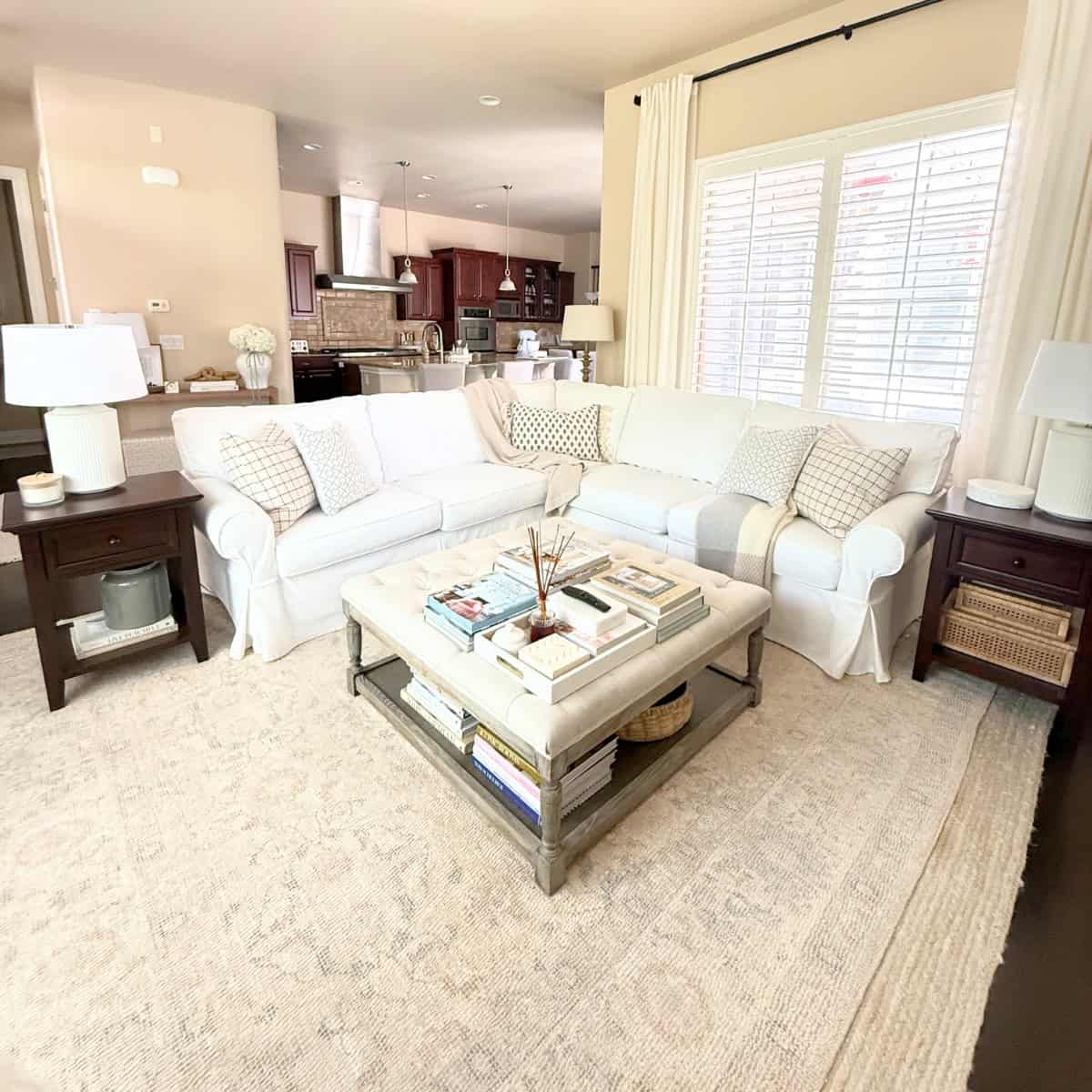
In our living room, we have the aforementioned patterned Loloi Priya/Amanda rug in 8 feet 6 inches x 12 feet that is layered on top of a larger 10x13 feet beautiful off white braided jute rug (similar, slightly smaller).
This ensured the combined rugs took up an appropriate amount of space in the room, while also making the room feel cozy.
I absolutely love a layered rug moment! Read more about How to Make Your Home Feel Cozy.
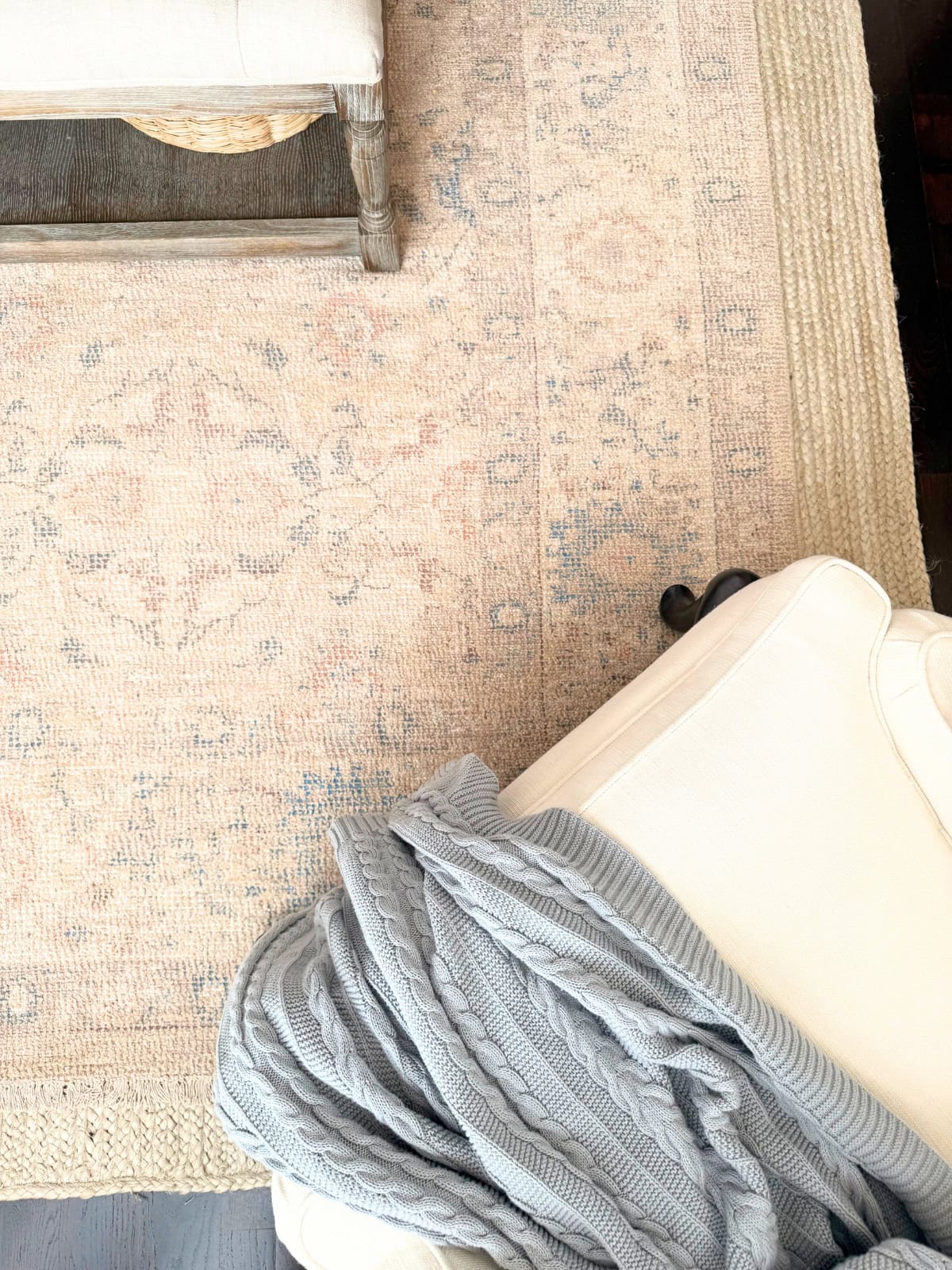
Below is a close up of the braided jute rug, one of my favorite rugs. The braiding is gorgeous and adds such wonderful texture to the room. Given the jute rug is off white, it complements colors in the patterned rug without standing out.
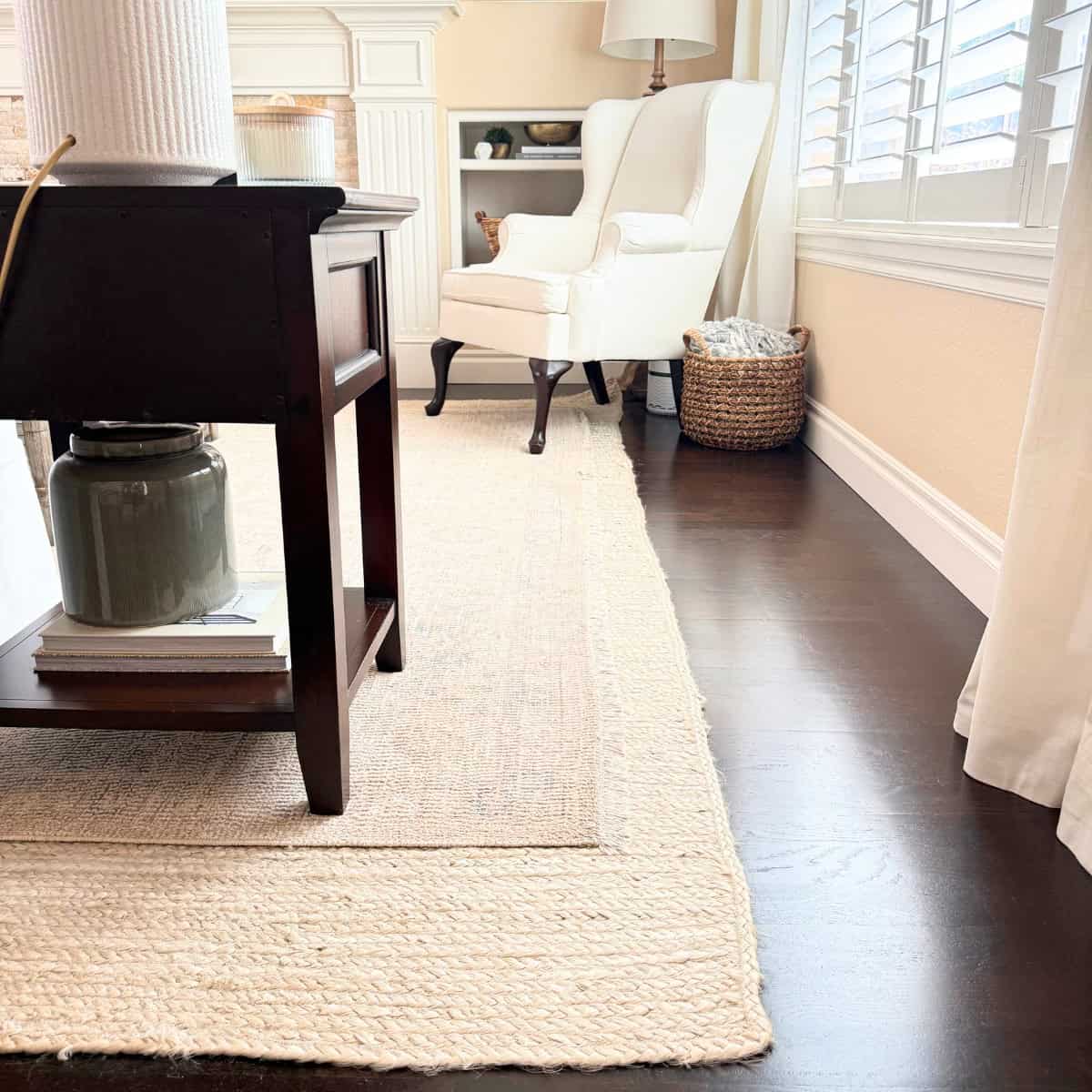
I briefly considered a darker brown color for the jute rug. Ultimately, I chose off white because it was more in line with colors in the pattern rug as well as our other furnishings.
Bedroom Rug Size
When picking out the best size rug for a bedroom, it usually comes down to the size of the bed. In general, if it fits in the room, follow this guide:
- Queen bed use an 8x10 feet rug
- King bed use a 9x12 feet or larger rug
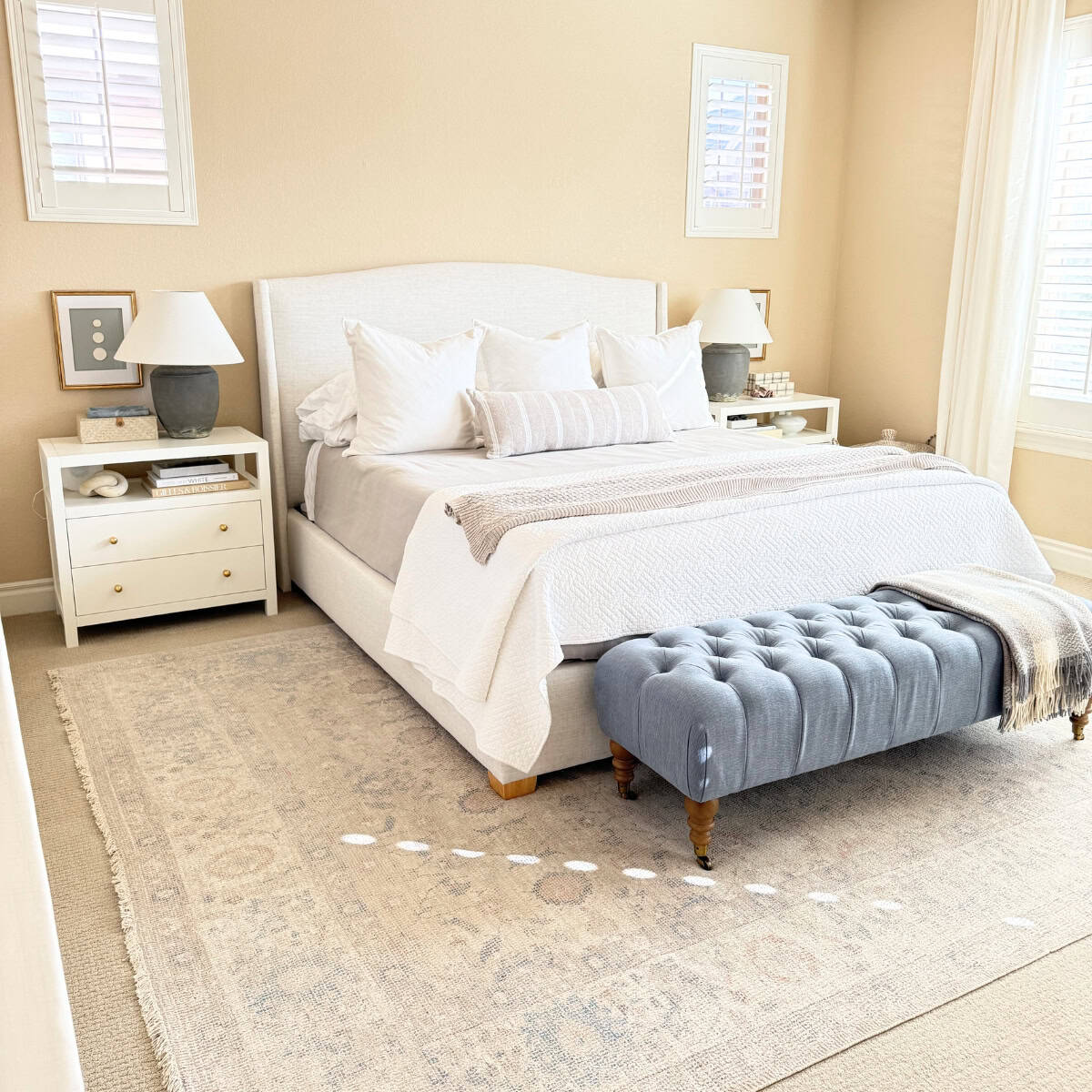
For wide nightstands, which is typical of a king bed especially, I like to make sure the rug is at least as wide as the span of both the nightstands and the bed combined. I don't like seeing a rug that does not extend to at least the same width, but that is my preference as opposed to a rule.
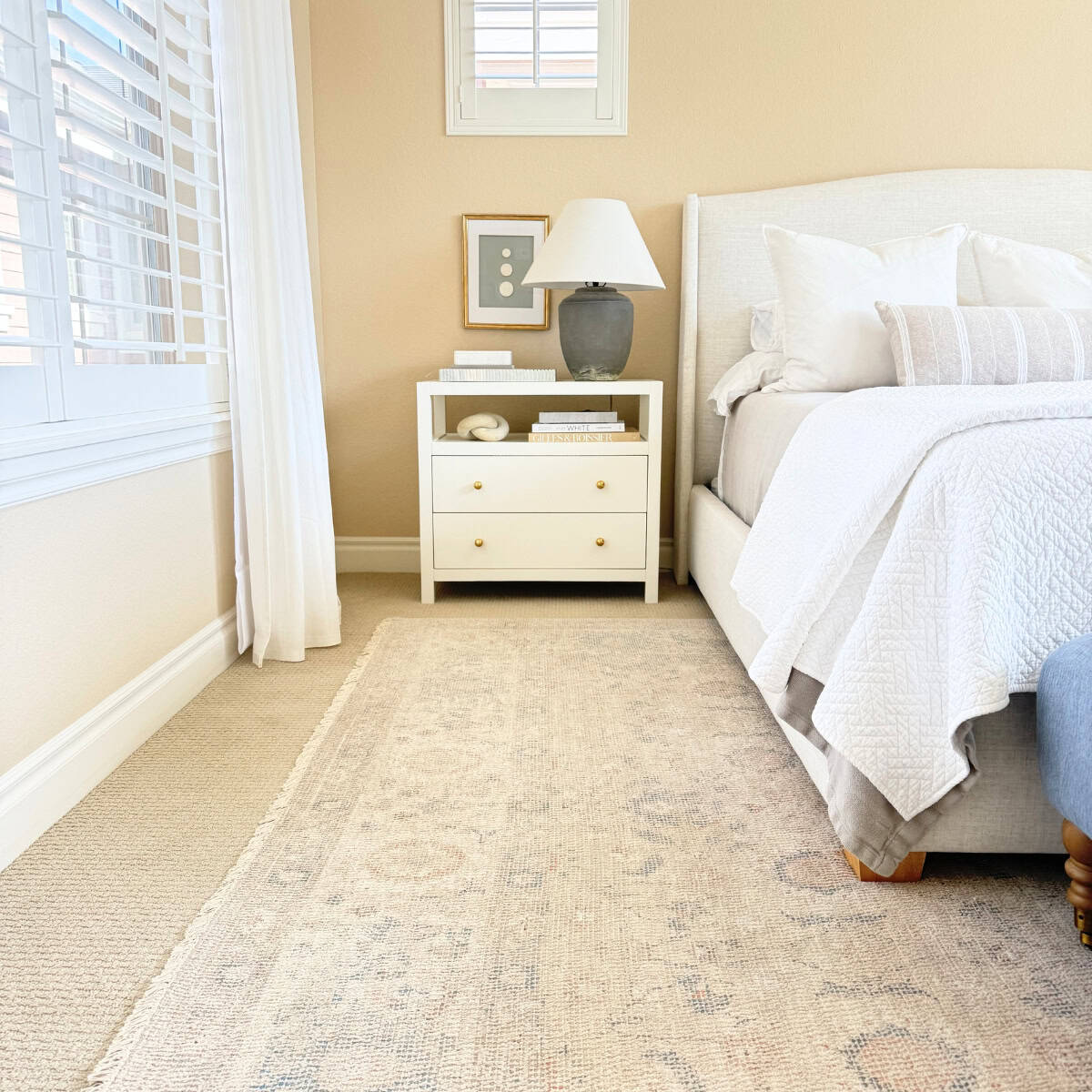
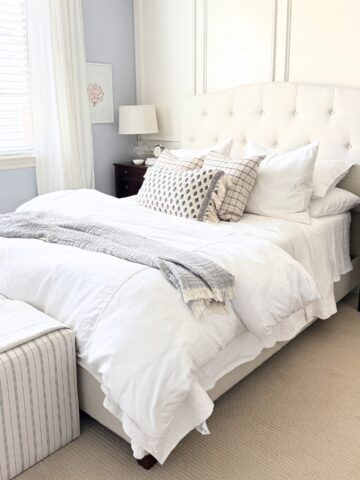
Our bedroom is fairly large at approximately 15x14 feet with only one location for the bed to be placed. We have neutral wall-to-wall carpeting, but I bought the same rug we have in our living room for our bedroom and layered it over the carpet.
Yes, you can layer a rug over carpeting. A patterned rug can do wonders when layered over wall-to-wall carpeting, including bringing in color, texture, and warmth.
At 8'6"x12 feet, the rug perfectly fits the room. It lines up with the wall to the left as you enter, and it spans the width of the nightstands and bed combined.
Entry Rug Size
The right size entry rug is more loose, in my view, than other areas of the home. Plus, space is always a factor for entryways. Some people are fine using a doormat size rug, such as 2x3 feet. If that works for you, go with it.
For those of us who have a front door with side lites, a larger rug, such as 3x5 feet, may look more balanced for the wider entry. As long as space allows, of course.
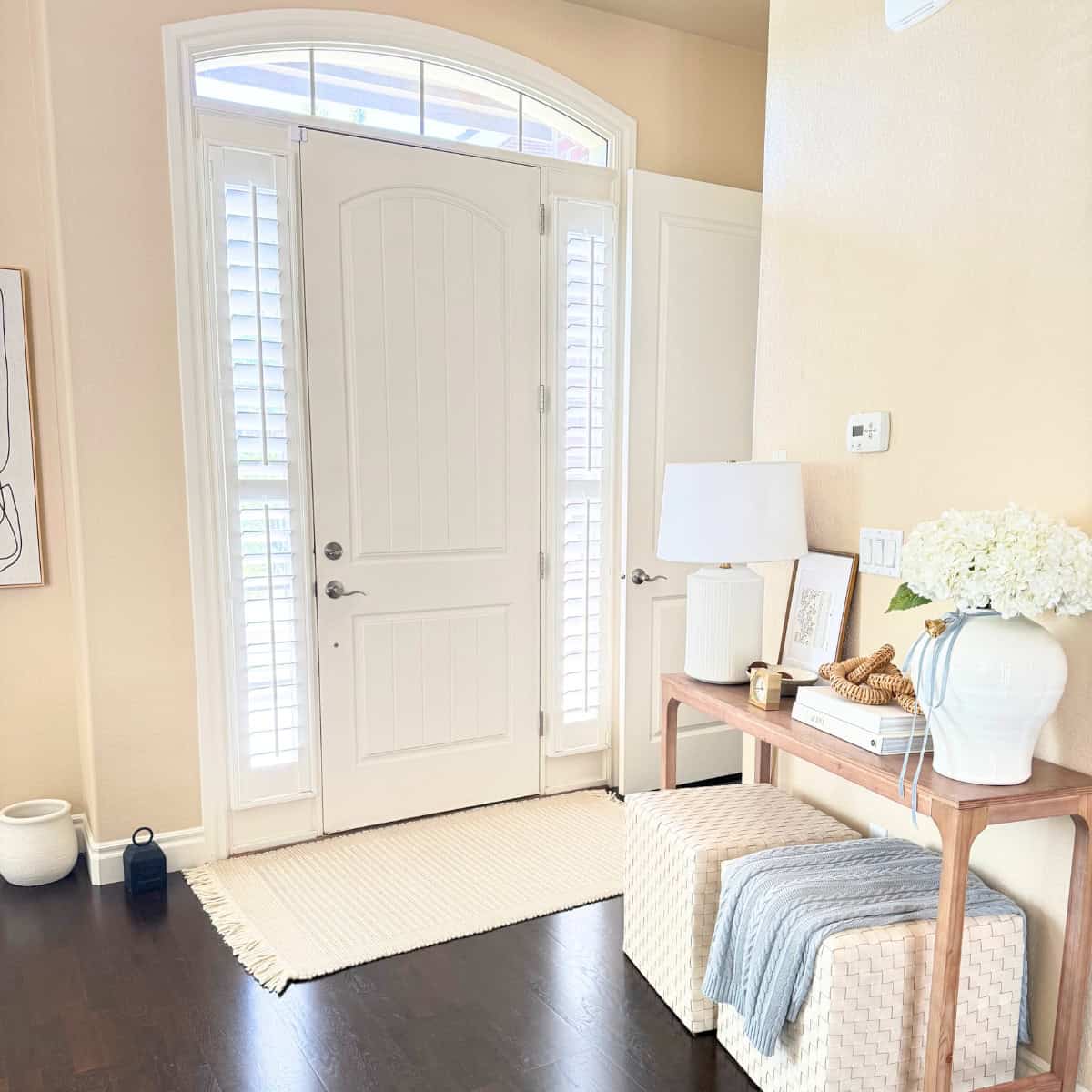
Shop the photo: Table lamp | Tall white large cachepot vase | Faux white hydrangea flowers | | Woven genuine leather ottoman (similar) | Rattan chain links | Blue cable knit cashmere throw blanket (similar) or Blue cable knit cotton throw blanket (similar) | AD at 100 book (bottom book) | Dusty blue velvet ribbon, shown as bow on the white vase
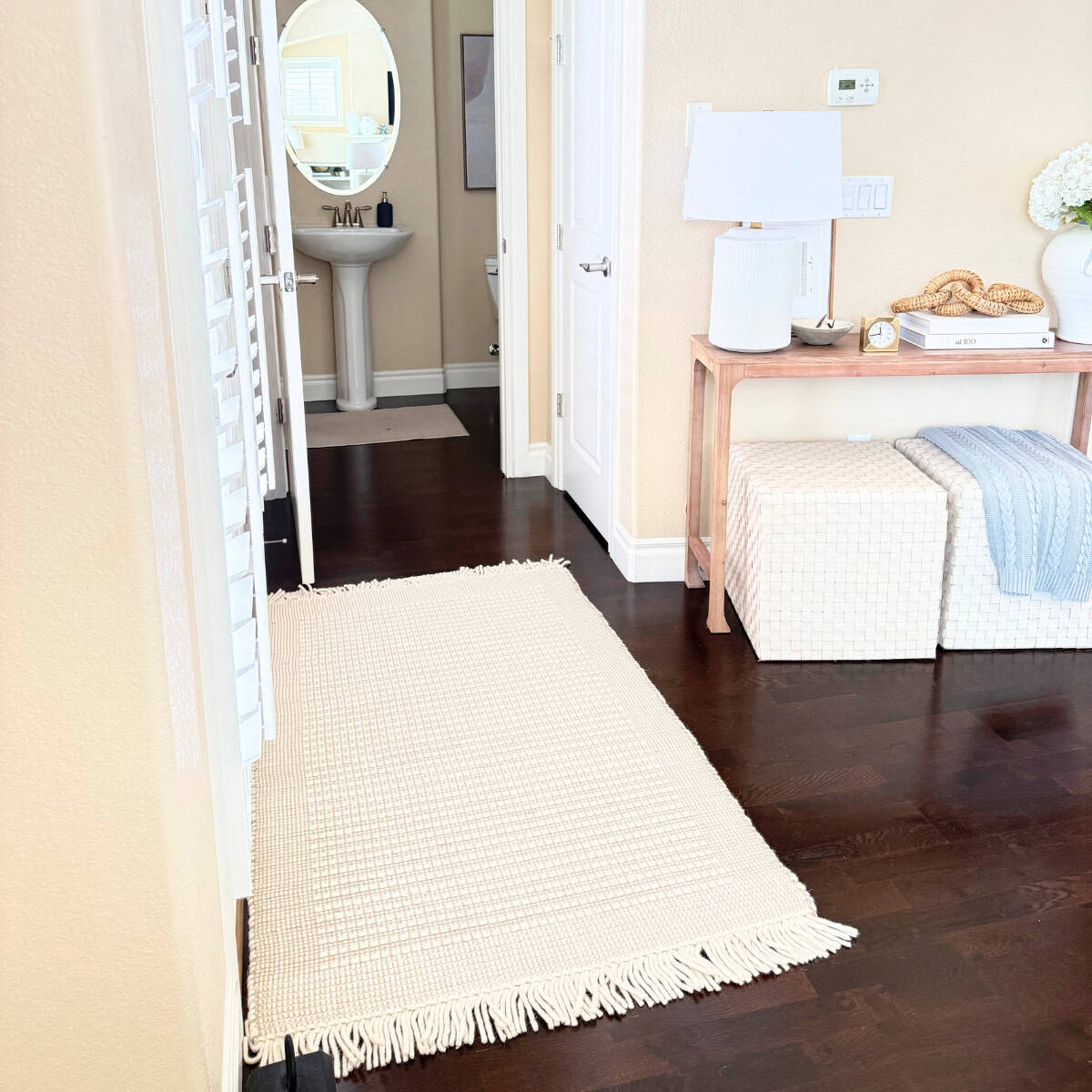
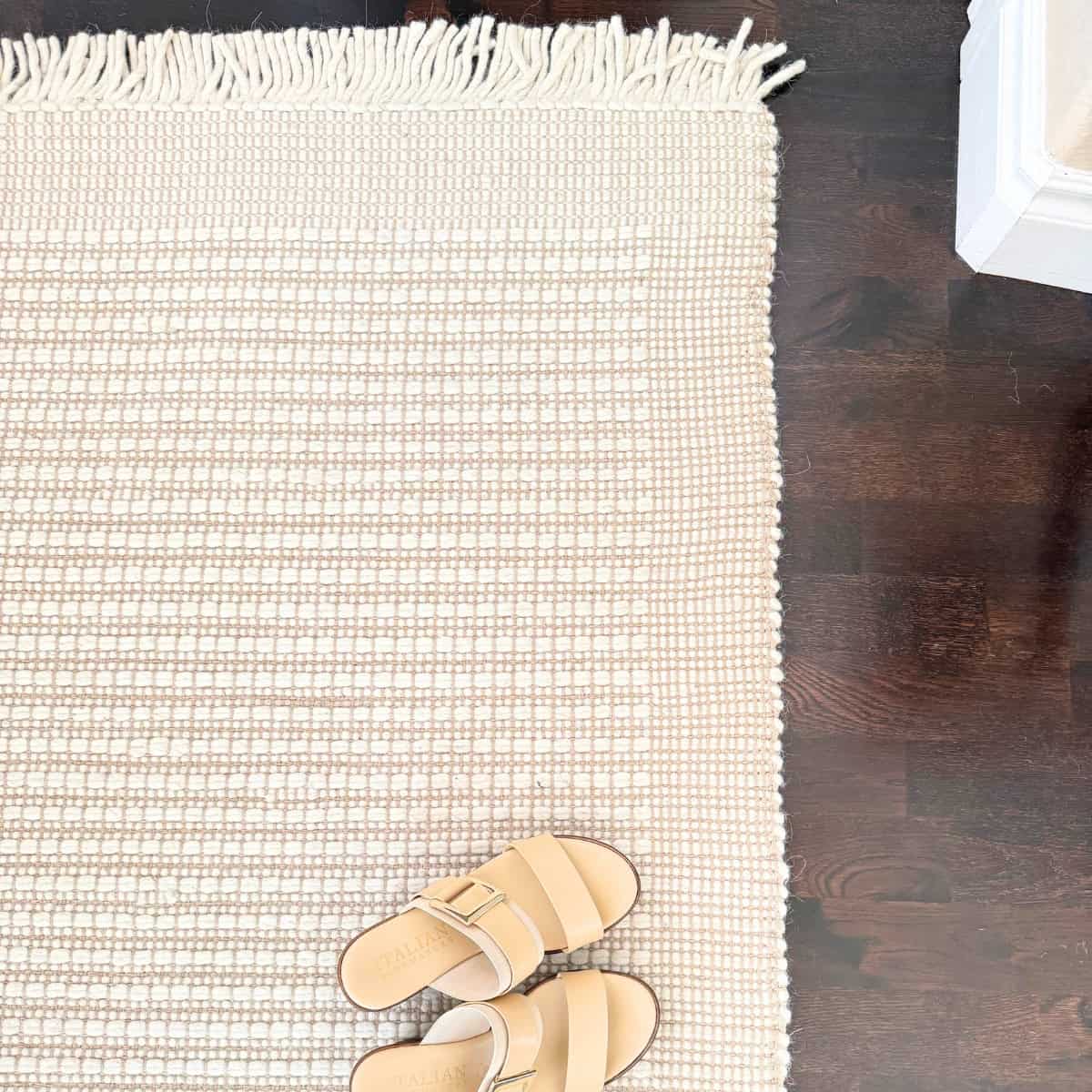
Our entryway has a wide door with side lites that I recently swapped a slightly smaller rug for this lovely textured 3x5 feet ivory rug that fully spans the doorway as well as provides more depth for guests as they step inside.
The rug is a neutral cotton-wool blend with a subtle pattern in the middle.
For truly large entryways, you can use a larger area rug and it would be appropriate for the space. You can get a sense of what I mean in Studio McGee's Home on the Ranch entryway tour video, where they used a very large area rug to balance the very large entry.
Dining Room Rug Size
The rule is simple for getting the right size dining room rug: When pulled out from the table, all chairs should be on the rug.
That means choosing a rug that is at least a few inches larger so all chairs always sit comfortably on the rug. This ensures no one is sitting on the edge or off of the rug at any point. You can absolutely go larger, but, at a minimum, all chairs need to comfortably be on the rug when pulled out from the table.
Home Office Rug Size
When it comes to rug sizes for a home office, you'll find many different answers. To me, it all depends on the layout of the room.
You could buy a rug that takes up all but a 12-18 inch border around the room. You could also place a rug up to the desk legs but not under, yet deep enough that when your chair is pulled out, the chair is still on the rug. You could have the desk and chair fully on the rug. Again, get out the painter's tape to visualize rug sizes you are considering.
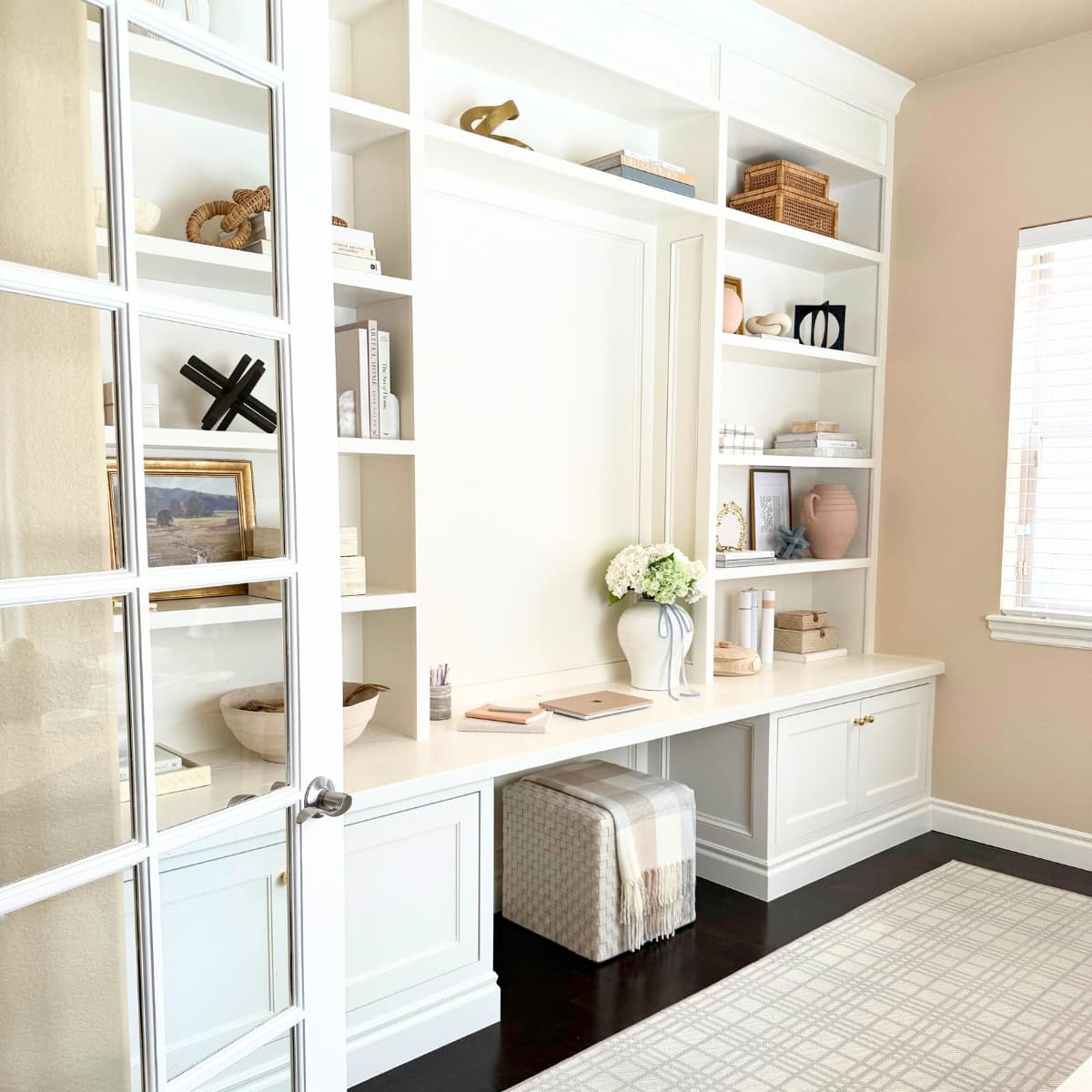
In our home office, a 6'7"x9'2" rug leaves about 11 inches of hardwood floor exposed on all sides. To me, this particular size makes the room look finished and not floating, which is the look I prefer.
The rug is a lovely plaid ivory/light grey indoor outdoor area rug made of polypropylene that also happens to be machine washable.
Kitchen Rug Size
Similar to an entry way rug size, I think a kitchen rug size is a little more loose. To me, this is more of a preference of function when using your space than aesthetic.
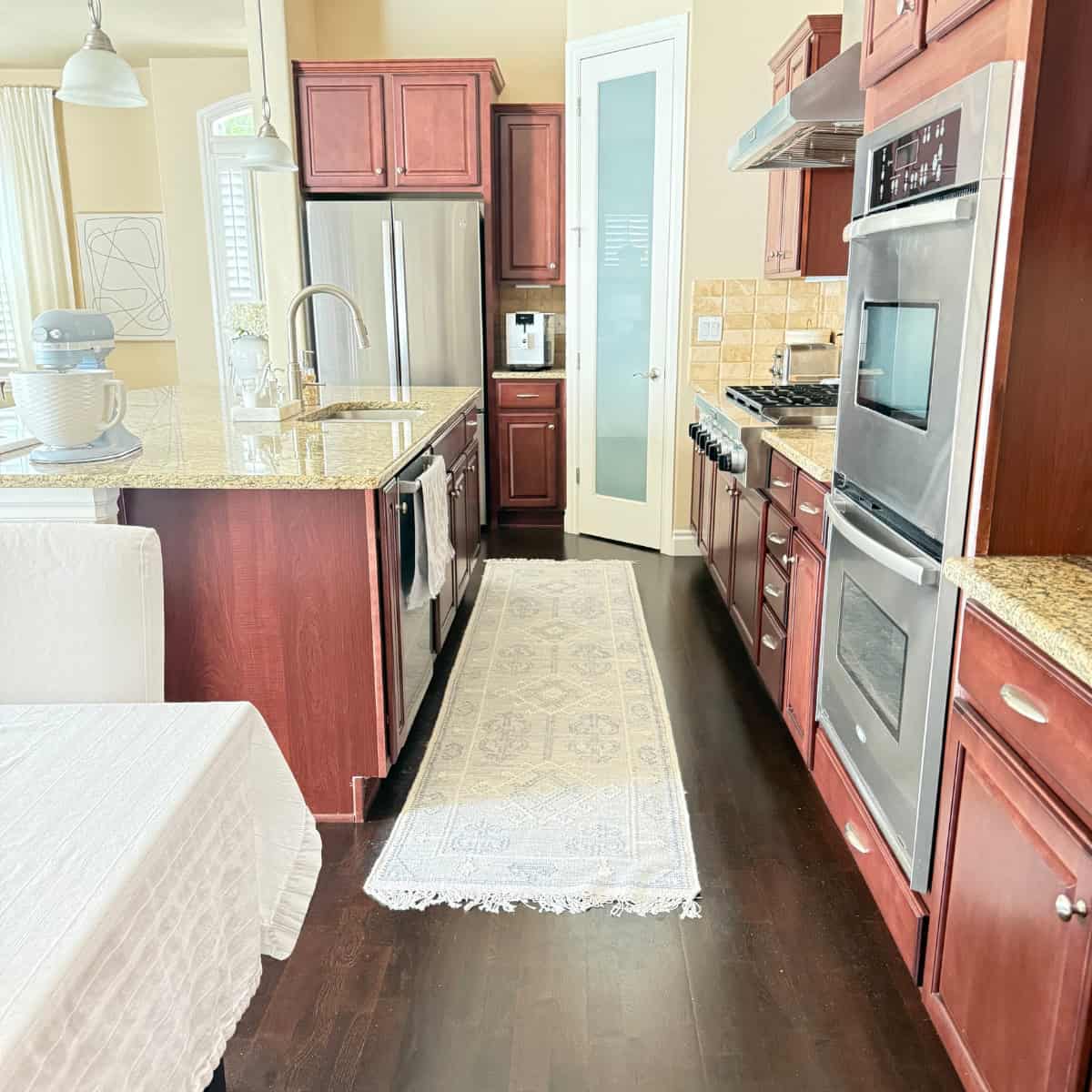
For a rug between the island and range wall, as an example, many designers would say to leave 3 to 6 inches on each side and to not let the runner extend beyond the ends of the island.
When you're actually using your kitchen, answer these questions:
- Would you mind walking on the edges of the runner?
- Would you prefer that the runner extend the full width so the edges go almost to the toe kick?
- Do you want a rug only in front of certain areas, such as in front of the sink and/or stove?
In each case, and depending on your kitchen space and layout, you could use a runner, a 2x3 feet rug, 3x5 feet rug, or larger if space allows. Measure, measure, measure, and use painter's tape to tape out various rug sizes you are considering as suggested earlier.
For our kitchen, I knew we should have a runner that would extend the length of the island. However, I don't mind if the runner extends past the ends of the island. In fact, I prefer when a runner peeks out from the island as I think it adds charm when looking into the kitchen from another room.
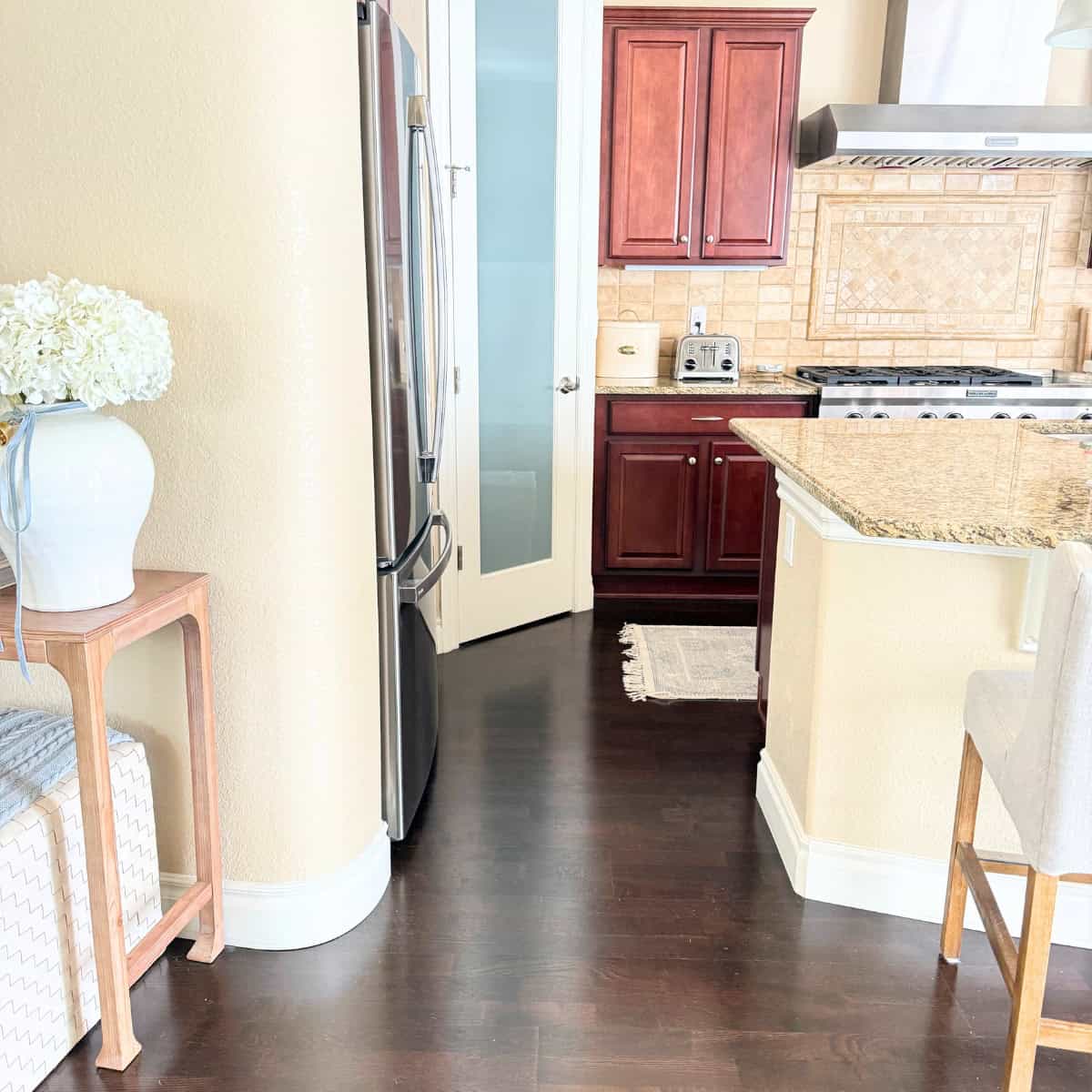
We have this 2.6x10 feet runner rug in Blue from Serena & Lily. Our rug extends beyond the ends of our island and I am very happy with how it looks. Moreover, I tucked our runner up against the sink side of the kitchen island to better protect our hardwood floors.
All in all, when shopping for rugs for any area of your home, try using painter's tape to tape out rug sizes in the space to see how it will look.
With these tips for how to choose a rug for any room, I hope you find a rug (or two or three) that works for your own home!
Leave a Reply